He dumped me, I wasn’t expecting that… or was I? I hate the heartbreak stage…
He did it at the worst possible moment. Just a few days ago we were on an amazing trip together, we were so close, we enjoyed each other so much, and after we came back… I don’t know maybe it was too much for him, I’m very sensitive, and I was on my period, I think I sensed it, I asked for security, and he decided to leave.
I forgot how much it hurts. Otherwise, none of us would ever risk loving again. You miss every single fucking detail, and now you think you won’t find someone you like, desire, and love that much again, “Idealization” right on time.
But you know what? Everyone goes through this. So it is not that special — this is biochemistry.
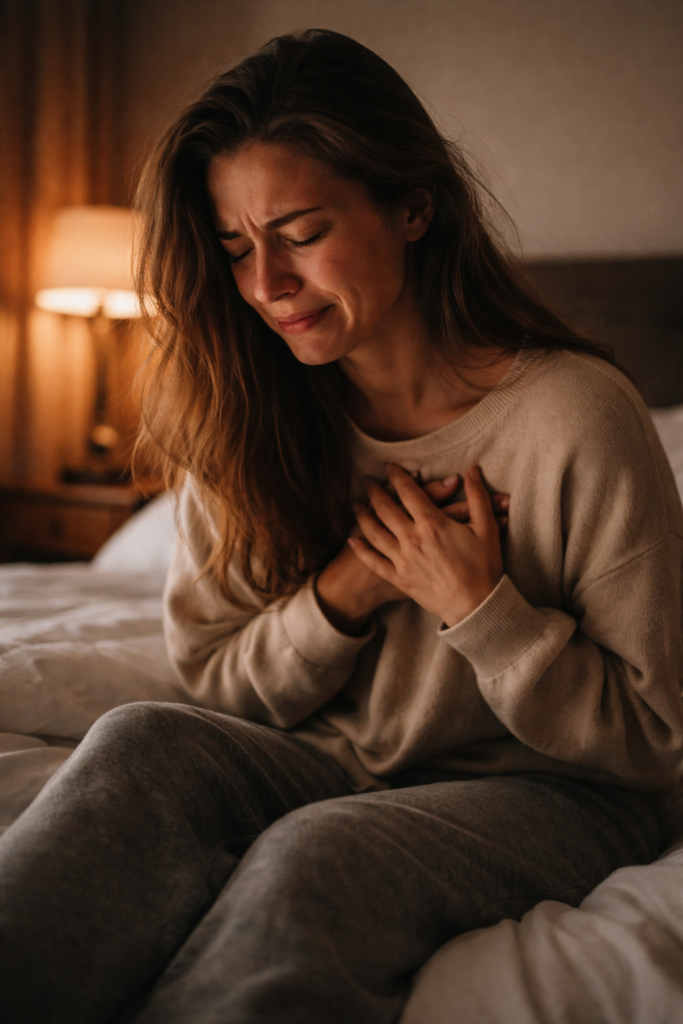
I cried in bed for a few days (three, to be precise) and then started to work and research, I firmly believe that pain has a reason to be.
The purpose of pain is to push you away from what you don’t want and toward what you do. But now, I don’t have a say in it. He made the choice. And as much as it can hurt, it also brings some great peace, and that is this: “There is nothing I can do about it”.
I can only focus on myself. And I don’t want to be with someone who doesn’t choose me.
So what now?
Tons of emotion. Memory. The entire pain fueled by hormones — yes, chemicals in the body.
Idealization? That’s a dopamine crash.
Missing his touch? Oxytocin withdrawal.
The goddamn chest pain when you wake up? Cortisol levels on the moon.
Then I realized, if this is biochemistry, maybe it can be regulated.
You’re in Withdrawal.
Let’s say it clearly.
You are in abstinence.
Scientists often describe heartbreak not as a metaphor, but as a state of chemical withdrawal and biological stress.
1️⃣ The Brain in Withdrawal
Anthropologist Helen Fisher conducted a landmark study using functional MRI scans on recently rejected individuals.
When participants were shown photos of their ex-partners, the scans revealed activation in the same brain regions associated with cocaine addiction withdrawal — particularly the ventral tegmental area (VTA), a core part of the dopamine reward system.
In other words:
Your brain reacts to romantic rejection the way an addicted brain reacts to losing its drug.
What’s happening biologically?
- Dopamine drops sharply.
During the relationship, dopamine floods the brain (reward, motivation, anticipation).
After separation, levels crash → anxiety, obsession, craving, the urge to “contact” for relief. - Oxytocin declines.
The bonding hormone decreases when physical closeness disappears.
This creates insecurity, physical longing, even a sensation of internal emptiness.
You are not dramatic.
You are in neurochemical withdrawal.
📚 Sources:
- Fisher, H.E., Brown, L.L., Aron, A., Strong, G., & Mashek, D. (2010). Reward, addiction, and emotion regulation systems associated with rejection in love. Journal of Neurophysiology.
https://www.jneurosci.org/content/30/1/327 - Fisher, H. (TED Talk) “Why We Love, Why We Cheat.”
https://www.ted.com/talks/helen_fisher_why_we_love_why_we_cheat
2️⃣ The Stress Hormone Cascade
When the reward system shuts down, the threat system turns on.
The body enters prolonged fight-or-flight mode.
The brain signals the adrenal glands to release:
- Cortisol
- Adrenaline
Physical effects:
Excess cortisol redirects blood flow away from digestion and toward muscles.
That explains:
- The knot in your stomach
- Loss of appetite
- Insomnia
- Morning dread
This is not weakness.
It’s a stress physiology response.
📚 Sources:
- Slavich, G.M., & Irwin, M.R. (2014). From stress to inflammation and major depressive disorder. Psychological Bulletin.
https://pubmed.ncbi.nlm.nih.gov/24798557/
3️⃣ Why It Hurts Physically
Emotional pain and physical pain share neural pathways.
Brain imaging studies show that social rejection activates:
- The anterior cingulate cortex (ACC)
- The insula
These are the same regions activated during physical pain (like burning your hand).
You’re not imagining the chest ache.
In extreme cases, stress can trigger Takotsubo cardiomyopathy, also known as “broken heart syndrome,” where part of the heart temporarily weakens due to a surge of stress hormones.
📚 Sources:
- Eisenberger, N.I., Lieberman, M.D., & Williams, K.D. (2003). Does rejection hurt? An fMRI study of social exclusion. Science.
https://www.science.org/doi/10.1126/science.1089134 - Mayo Clinic – Broken Heart Syndrome
https://www.mayoclinic.org/diseases-conditions/broken-heart-syndrome
4️⃣ Your Immune System Takes a Hit
Chronic post-breakup stress can increase inflammatory markers in the bloodstream.
Elevated pro-inflammatory cytokines may temporarily weaken immune defenses, making you more vulnerable to colds or viral infections in the weeks following separation.
Heartbreak affects the whole organism.
📚 Source:
- Kiecolt-Glaser, J.K. et al. (2011). Marital stress and wound healing. Archives of General Psychiatry.
https://jamanetwork.com/journals/jamapsychiatry/fullarticle/210905
What You’re Feeling (And What To Do About It)
🌀 Idealization
Dopamine crash
You’re not just missing him. You’re missing the reward system.
When anticipated reward disappears, dopamine drops. That’s why you romanticize, crave contact, forget incompatibilities.
This is withdrawal.
What helps:
- Introduce novelty (new places, new routines)
- Physical intensity (strength training > passive scrolling)
- Complete small tasks daily (a list with checks helps)
- No contact — you don’t stabilize dopamine by micro-dosing it
💔 Chest Pain in the Morning
Cortisol spike
When attachment breaks, the nervous system interprets it as threat. Cortisol rises. That’s why mornings feel heavier.
What helps:
- Sunlight within 10–15 minutes of waking
- Slow exhale breathing
- Move your body before thinking
- No phone first thing
You calm cortisol with safety signals, not analysis.
And the morning routine I like? Just three to five minutes of intense jump rope. Then a cold shower. I’m not a fan of cold showers — but in this case, I love them. They reset your system fast. They calm your mind and body when you need it most
🤍 “I Need Him Close”
Oxytocin withdrawal
You miss the closeness. The physical regulation. The warmth.
That’s bonding chemistry.
What helps:
- Physical contact with safe people
- Contact or play with your pets
- Some yoga
- Hugs longer than feels natural
- Warm showers or baths
- Social presence (even silent presence counts)
Isolation intensifies this one.
🔁 Rumination & Replay
Serotonin imbalance + stress chemistry
Replaying conversations. Trying to solve it. Editing the past.
Low serotonin and stress hormones amplify obsessive loops.
What helps:
- Write the full narrative once — then stop rewriting it
- Sunlight within 10–15 minutes of waking up.
- Slow breathing (4-7-8 method): inhale for 4 seconds, hold for 7, exhale for 8.
- Aerobic movement: ride your bike, go for a brisk walk, or do light cardio.
Clarity does not come from repetition.
What Helps When Everything Is Activated at Once?
Sometimes it’s not just dopamine.
Not just cortisol.
Not just oxytocin.
Sometimes it’s all of it at the same time.
When that happens, two powerful regulators stand out:
1️⃣ Orgasm (Yes, Really)
Orgasm triggers the release of dopamine, oxytocin, endorphins, and prolactin — many of the same chemicals that drop during heartbreak.
In other words, your body has an internal pharmacy.
If you choose to, approach it consciously.
Take your time.
Create an atmosphere.
Play music.
Be present in your body.
And don’t use it to mentally rehearse the relationship.
This is about reconnecting with yourself — not replaying the past.
It’s regulation, not escape.
2️⃣ Meditation
Meditation directly impacts cortisol levels and nervous system regulation.
It lowers sympathetic activation (fight-or-flight) and increases parasympathetic tone (rest-and-digest).
Find a guided meditation that feels safe.
Follow it consistently.
Even 10 minutes can shift your internal state.
This is not spiritual bypassing.
It’s nervous system recalibration.
Something Important
Before closing, something important.
This biochemical system is not exclusive to you.
Attachment is not unilateral.
Bonding is not one-sided.
Oxytocin does not only drop in one body.
He made the decision. That means his system activated differently. Maybe distance felt safer. But biology does not disappear because someone chooses to leave.
At some point — not necessarily now, not necessarily in the same way — his system will recalibrate too.
You do not disappear from someone’s nervous system overnight.
But this is human data, not an emotional anchor.
Do not use this to wait for him.
Do not use this to fantasize about his future pain.
It does not change what he did.
It does not change your focus.
And it does not change the fact that you must choose to be with someone who chooses you.
Not only when your absence hurts.
But because your presence is valued.
Enjoyed.
Respected.
Even when things get difficult.
That is the standard.