

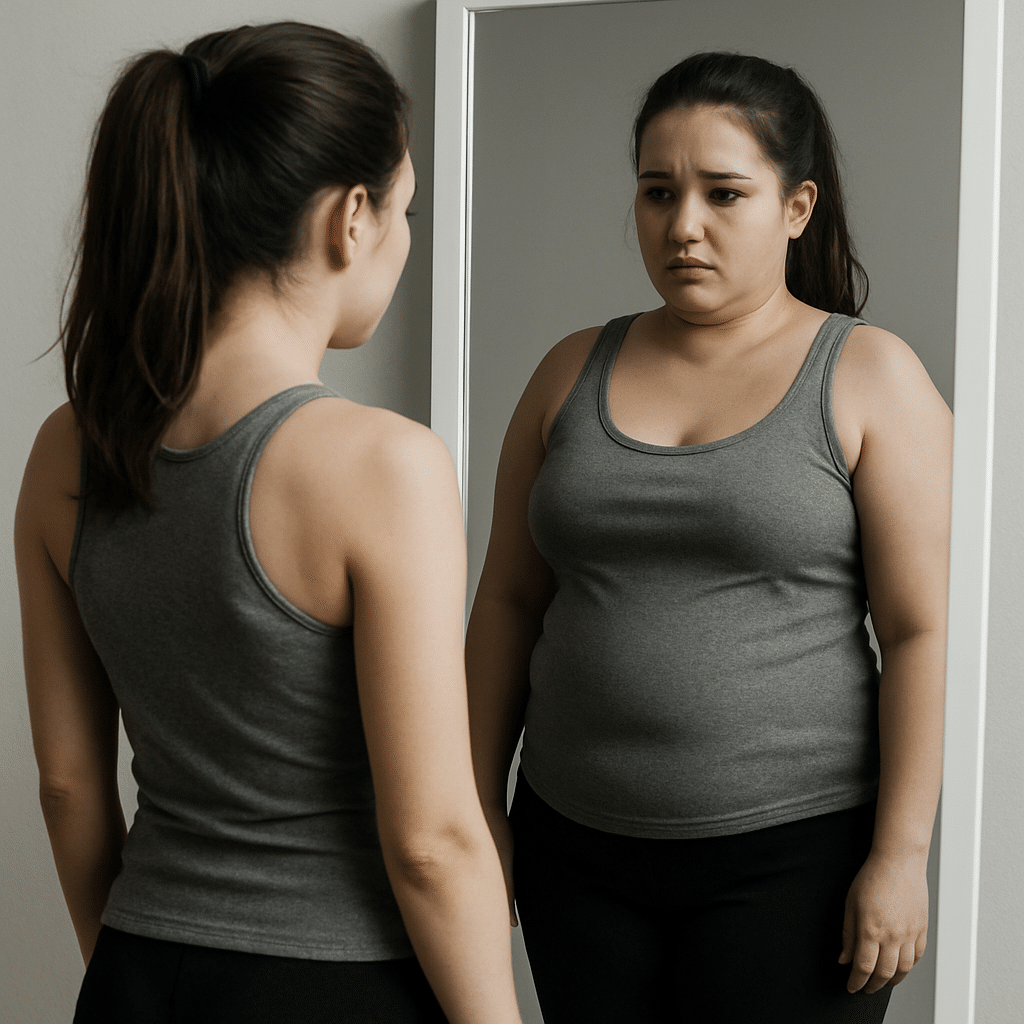
Understanding Body Dysmorphia, Self-Perception, and Body Image Distortion
The other day, during a conversation, someone asked me a simple — yet brutal — question:
“What would you think of another woman who had your exact same body?”
I opened my mouth to answer… and nothing came out.
Not because I didn’t want to respond, but because I couldn’t even picture my own body. I literally couldn’t form the image in my mind.
Why?
How is it possible to live inside a body every single day and still have no idea how it actually looks?
That’s when I realized:
Maybe I don’t have a real perception of my body.
Body Image Is Not Just What You See — It’s What Your Brain Lets You See
We think body image is visual, but it’s not. It’s psychological.
Your physical body can be one thing — while your internal image of it is something completely different.
This inner image is shaped by four key factors:
- Perception — how your brain filters what you see
- Identity — the story you carry about who you’re “allowed” to be
- Emotional history — traces of old comments, comparisons, shame or praise
- Internal standards — the silent rules that define what “good enough” looks like.
Most of this is affected by social standars.
Put simply:
You don’t see your body as it is — you see it as your history told you it is.
Why Can a Woman Have an Amazing Body and Still Not See It?
Because the brain runs on maps, not mirrors.
If your “body map” was formed years ago — maybe when you felt insecure, rejected, or compared — your mind will keep projecting that outdated version of you even if your real body has changed.
Common Signs of Distorted Body Perception:
- You look back at old photos and think “I actually looked great — why didn’t I see it?”
- You receive compliments that don’t register
- You feel bigger or smaller than you are, depending on your mood
- You avoid the mirror or overanalyze it — yet neither reflection feels accurate
This is mild body dysmorphia. Not necessarily a clinical condition — but a gap between reality and perception.
The Mirror Experiment That Exposes Everything
There’s a psychological experiment that perfectly illustrates this phenomenon.
A group of women were asked not to look in a mirror for 2 days.
Day 1: They were told they’d receive a full professional makeover — hair, makeup, styling. After the “glow up,” they were sent out into the world.
Day 2: They went out with nothing. Natural face. No styling.
Afterwards, they were asked:
“Which day did you feel more attractive?”
Every single one said Day 1.
They swore people reacted better to them — more smiles, more attention, better energy.
The twist?
They never got the makeover.
The “glow up” was fake. No one touched their faces.
They looked exactly the same both days.
The only thing that changed?
Their belief about themselves — and that belief changed their energy, posture, body language, and the way they showed up in the world.
This video explains it beautifully
How Do You Know If You See Yourself Clearly? 7 Warning Signs
Here are real signs of distorted body image — even if you don’t “hate” your body:
✓ Struggle to imagine what you look like (like I did)
✓ Compliments feel confusing instead of affirming
✓ You over-focus on one “problem area” and ignore the rest
✓ Reflection changes depending on lighting, mood or comparison
✓ Disconnected from your sensuality, strength or physical presence
If any of that sounds familiar, your body is not the issue.
Your body map is outdated.
How to Start Realigning Your Self-Image With Reality
Forget affirmations. Forget “just love yourself.” That rarely works.
To actually correct body perception, you need to retrain how your brain registers your physical presence.
4 Science-Backed Techniques to Update Your Body Image:
1. Use mirrors without judging — just observing. Look at your body like you would look at another woman. Neutral. Descriptive. No moral value.
2. Record yourself walking / moving. Not posing — existing. This reveals your real shape in motion.
3. Touch your body with attention. Not to fix it — but to feel it. Ownership begins through sensation.
4. Borrow another woman’s lens. Imagine someone else living in your body — how would she carry it?
These practices update the neural map — not just the surface image.
Final Thought: Maybe you Don’t Need to change your Body — You Need a New Perspective
I used to think body dysmorphia was extreme — something only people with eating disorders struggled with.
Now I believe many women silently live with micro-dysmorphia. Not hatred. Not obsession. Just disconnection.
And that’s what I’m choosing to change.
Because maybe my body never needed to be different.
Maybe I just needed to finally meet it.
Maybe you don’t need a new body.Maybe you just need a new point of view.